The Most Argumentative Creature: The Difference Between Seeking Truth and Needing to Be Right
A reflection on Quran 18:54 and related verses about argument, seeking truth, the need to be right, evidence, verification, justice, humility, and debating in the best manner.
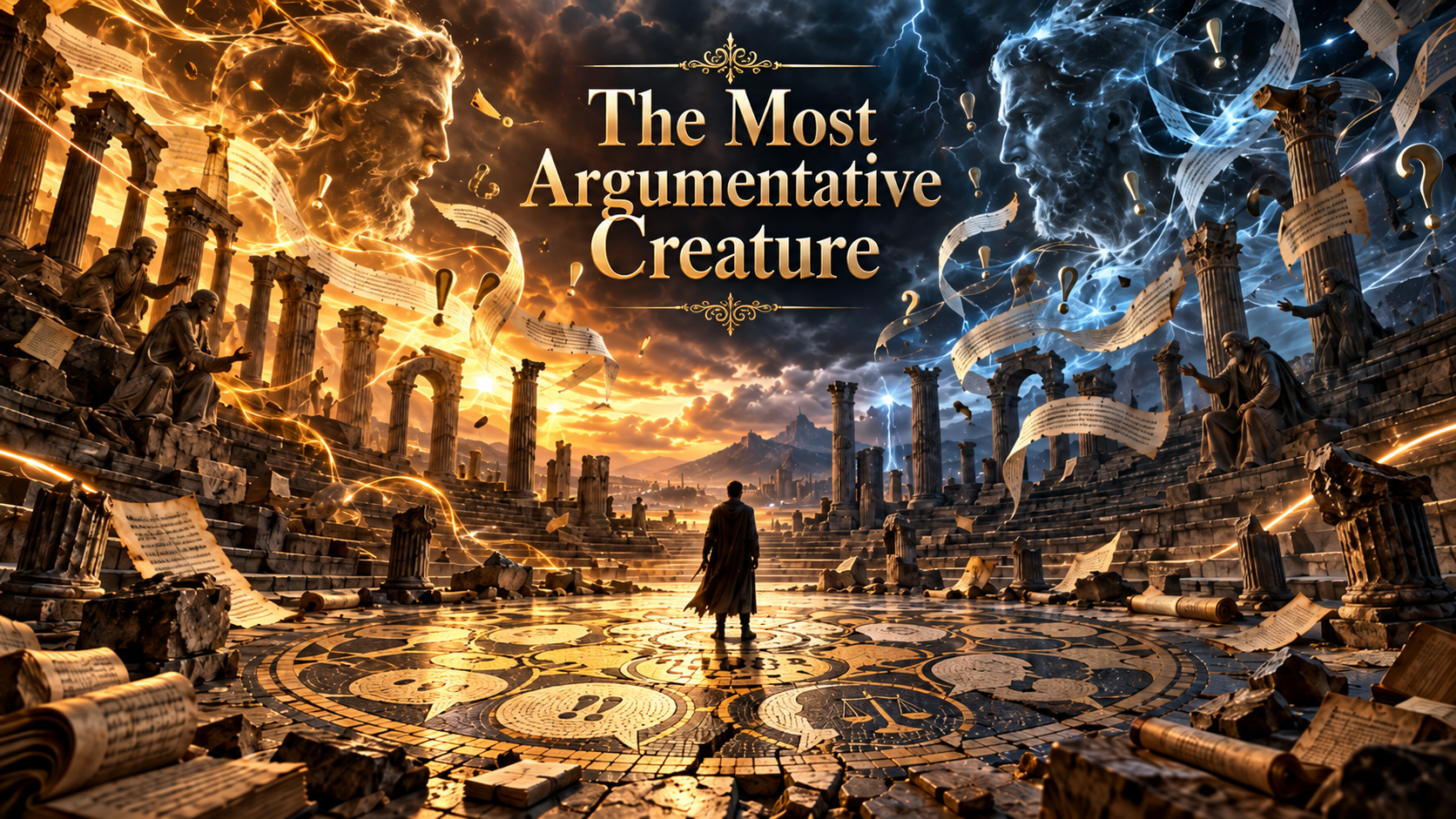
The Most Argumentative Creature: The Difference Between Seeking Truth and Needing to Be Right
Author: Berk KÖKSAL
Date: September 16, 2026
Place: Mersin
The central purpose of this article is to contemplate the verses together with other related verses, and to consider sincerely and deeply what bearing witness to the oneness of GOD means in human life in terms of knowledge, justice, truthfulness, and submission.
Peace. Peace be upon you.
Human beings can question, compare, object, explain, and defend. Argument is not automatically a defect. It can be part of a sincere search for truth. Yet the same ability can also become a tool of the ego: a way to avoid admitting uncertainty, protect status, defend inherited positions, or win before an audience.
18:54 places this tendency under a severe light. The Quran has cited every kind of example, yet the human being is described as “the most argumentative creature.” The question that follows for me is not whether I ever argue. It is what I become while arguing. Can evidence change me, or do I only use evidence that protects what I already want to believe?
The Quran does not simply abolish debate. 16:125 commands debate in the best possible manner. That means the real distinction is between argument that serves truth and argument that serves the self.
Summary:
1. Why Is the Human Being Called the Most Argumentative Creature?
18:54
وَلَقَدْ صَرَّفْنَا فِى هَٰذَا ٱلْقُرْءَانِ لِلنَّاسِ مِن كُلِّ مَثَلٍ وَكَانَ ٱلْإِنسَٰنُ أَكْثَرَ شَىْءٍ جَدَلًا
We have cited in this Quran every kind of example, but the human being is the most argumentative creature.
Biz bu Kuran’da her türden örneği verdik, fakat insan en tartışmacı yaratıktır.
2. Arguing About GOD Without Knowledge
22:3 — Among the people, there are those who argue about GOD without knowledge, and follow every rebellious devil.
22:8 — Among the people there is the one who argues about GOD without knowledge, and without guidance, and without an enlightening scripture.
3. Argument Without Basis and the Danger of Arrogance
40:35 — They argue against GOD’s revelations, without any basis. This is a trait that is most abhorred by GOD and by those who believe. GOD thus seals the hearts of every arrogant tyrant.
4. The Pride Hidden Inside the Chest
40:56 — Surely, those who argue against GOD’s revelations without proof are exposing the arrogance that is hidden inside their chests, and they are not even aware of it. Therefore, seek refuge in GOD; He is the Hearer, the Seer.
5. The Boundary Between What I Know and What I Do Not Know
3:66 — You have argued about things you knew; why do you argue about things you do not know? GOD knows, while you do not know.
6. Verification Before Acceptance
17:36 — You shall not accept any information, unless you verify it for yourself. I have given you the hearing, the eyesight, and the brain, and you are responsible for using them.
7. Examining Words and Following the Best
39:18 — They are the ones who examine all words, then follow the best. These are the ones whom GOD has guided; these are the ones who possess intelligence.
8. Unverified News Can Become Injustice
49:6 — O you who believe, if a wicked person brings any news to you, you shall first investigate, lest you commit injustice towards some people, out of ignorance, then become sorry and remorseful for what you have done.
9. Wisdom, Kind Enlightenment, and the Best Possible Manner
16:125 — You shall invite to the path of your Lord with wisdom and kind enlightenment, and debate with them in the best possible manner. Your Lord knows best who has strayed from His path, and He knows best who are the guided ones.
10. Disagreement Without Dehumanization
29:46 — Do not argue with the people of the scripture (Jews, Christians, & Muslims) except in the nicest possible manner—unless they transgress— and say, “We believe in what was revealed to us and in what was revealed to you, and our god and your god is one and the same; to Him we are submitters.”
11. The Best Response Can Change the Relationship
41:34 — Not equal is the good response and the bad response. You shall resort to the nicest possible response. Thus, the one who used to be your enemy, may become your best friend.
41:35 — None can attain this except those who steadfastly persevere. None can attain this except those who are extremely fortunate.
12. Self-Exaltation Can Poison the Search for Truth
53:32 — They avoid gross sins and transgressions, except for minor offenses. Your Lord’s forgiveness is immense. He has been fully aware of you since He initiated you from the earth, and while you were embryos in your mothers’ bellies. Therefore, do not exalt yourselves; He is fully aware of the righteous.
13. Justice Even Against Myself
4:135 — O you who believe, you shall be absolutely equitable, and observe GOD, when you serve as witnesses, even against yourselves, or your parents, or your relatives. Whether the accused is rich or poor, GOD takes care of both. Therefore, do not be biased by your personal wishes. If you deviate or disregard (this commandment), then GOD is fully Cognizant of everything you do.
14. Conflict Does Not Permit Injustice
5:8 — O you who believe, you shall be absolutely equitable, and observe GOD, when you serve as witnesses. Do not be provoked by your conflicts with some people into committing injustice. You shall be absolutely equitable, for it is more righteous. You shall observe GOD. GOD is fully Cognizant of everything you do.
15. Repeating Claims Without Proof
24:15 — You fabricated it with your own tongues, and the rest of you repeated it with your mouths without proof. You thought it was simple, when it was, according to GOD, gross.
16. When Speech and Life Separate
61:2 — O you who believe, why do you say what you do not do?
61:3 — Most abominable in the sight of GOD is that you say what you do not do.
17. Conjecture Is No Substitute for Truth
10:36 — Most of them follow nothing but conjecture, and conjecture is no substitute for the truth. GOD is fully aware of everything they do.
18. Truth Does Not Need Forced Acceptance
18:29 — Proclaim: “This is the truth from your Lord,” then whoever wills let him believe, and whoever wills let him disbelieve. We have prepared for the transgressors a fire that will completely surround them. When they scream for help, they will be given a liquid like concentrated acid that scalds the faces. What a miserable drink! What a miserable destiny!
19. Arabic Word Roots: Argument, Knowledge, Proof, and Truth
18:54 — We have cited in this Quran every kind of example, but the human being is the most argumentative creature.
22:8 — Among the people there is the one who argues about GOD without knowledge, and without guidance, and without an enlightening scripture.
40:56 — Surely, those who argue against GOD’s revelations without proof are exposing the arrogance that is hidden inside their chests, and they are not even aware of it. Therefore, seek refuge in GOD; He is the Hearer, the Seer.
Other Claims
18:54 — We have cited in this Quran every kind of example, but the human being is the most argumentative creature.
Conclusion
18:54 — We have cited in this Quran every kind of example, but the human being is the most argumentative creature.
17:36 — You shall not accept any information, unless you verify it for yourself. I have given you the hearing, the eyesight, and the brain, and you are responsible for using them.
39:18 — They are the ones who examine all words, then follow the best. These are the ones whom GOD has guided; these are the ones who possess intelligence.
49:6 — O you who believe, if a wicked person brings any news to you, you shall first investigate, lest you commit injustice towards some people, out of ignorance, then become sorry and remorseful for what you have done.
4:135 — O you who believe, you shall be absolutely equitable, and observe GOD, when you serve as witnesses, even against yourselves, or your parents, or your relatives. Whether the accused is rich or poor, GOD takes care of both. Therefore, do not be biased by your personal wishes. If you deviate or disregard (this commandment), then GOD is fully Cognizant of everything you do.
5:8 — O you who believe, you shall be absolutely equitable, and observe GOD, when you serve as witnesses. Do not be provoked by your conflicts with some people into committing injustice. You shall be absolutely equitable, for it is more righteous. You shall observe GOD. GOD is fully Cognizant of everything you do.
16:125 — You shall invite to the path of your Lord with wisdom and kind enlightenment, and debate with them in the best possible manner. Your Lord knows best who has strayed from His path, and He knows best who are the guided ones.
29:46 — Do not argue with the people of the scripture (Jews, Christians, & Muslims) except in the nicest possible manner—unless they transgress— and say, “We believe in what was revealed to us and in what was revealed to you, and our god and your god is one and the same; to Him we are submitters.”
53:32 — They avoid gross sins and transgressions, except for minor offenses. Your Lord’s forgiveness is immense. He has been fully aware of you since He initiated you from the earth, and while you were embryos in your mothers’ bellies. Therefore, do not exalt yourselves; He is fully aware of the righteous.
1. Why Is the Human Being Called the Most Argumentative Creature?
Verse
18:54
وَلَقَدْ صَرَّفْنَا فِى هَٰذَا ٱلْقُرْءَانِ لِلنَّاسِ مِن كُلِّ مَثَلٍ وَكَانَ ٱلْإِنسَٰنُ أَكْثَرَ شَىْءٍ جَدَلًا
We have cited in this Quran every kind of example, but the human being is the most argumentative creature.
Biz bu Kuran’da her türden örneği verdik, fakat insan en tartışmacı yaratıktır.
Source: kuranteyit.com
Reflection on the Verse
18:54 joins two ideas that deserve to be read together: many kinds of examples have been given, and the human being remains intensely argumentative. The obstacle, then, is not always the absence of explanation.
A question can be an opening toward truth. But a question can also be a delaying tactic when the answer threatens the identity we have built. Once I have publicly defended a position, changing my mind may feel like losing part of myself.
The verse speaks about the human being, not merely about “other people.” I am included. My intelligence can examine evidence, but it can also manufacture sophisticated excuses. The ethical question is whether reason is serving truth or protecting pride.
Verse references: 18:54.
2. Arguing About GOD Without Knowledge
Verse
22:3 — Among the people, there are those who argue about GOD without knowledge, and follow every rebellious devil.
22:8 — Among the people there is the one who argues about GOD without knowledge, and without guidance, and without an enlightening scripture.
Reflection on the Verse
22:3 and 22:8 describe argument about GOD without knowledge. The second verse intensifies the problem: no knowledge, no guidance, and no enlightening scripture, yet the argument continues.
This is a serious warning for religious speech. Saying “GOD certainly wants this” or “GOD absolutely condemns that” carries more weight than ordinary opinion. If the claim cannot be grounded, confidence does not make it revelation.
In The Steps of Satan, I reflected on the danger of saying about GOD what we do not know. These verses show the same danger inside debate. A person may believe he is defending GOD while actually defending his own construction of GOD.
One of the most honest sentences in religious discussion may therefore be, “I do not know.”
Verse references: 22:3; 22:8; 2:169; 2:32.
3. Argument Without Basis and the Danger of Arrogance
Verse
40:35 — They argue against GOD’s revelations, without any basis. This is a trait that is most abhorred by GOD and by those who believe. GOD thus seals the hearts of every arrogant tyrant.
Reflection on the Verse
40:35 does not condemn every objection. It condemns argument against GOD’s revelations “without any basis.” That distinction protects sincere inquiry while exposing resistance that has no evidence behind it.
The verse also connects such argument with arrogance. Sometimes the problem is not that the evidence is unclear, but that retreat feels humiliating. The debate then stops being about what is true and becomes about preserving authority.
Religious knowledge can either humble a person before GOD or become material for self-importance. The difference may be visible in how easily we admit error.
Verse references: 40:35.
4. The Pride Hidden Inside the Chest
Verse
40:56 — Surely, those who argue against GOD’s revelations without proof are exposing the arrogance that is hidden inside their chests, and they are not even aware of it. Therefore, seek refuge in GOD; He is the Hearer, the Seer.
Reflection on the Verse
40:56 is especially unsettling because it says the pride behind argument may be hidden even from the person himself. We can misread our own motives.
“I am only defending truth” may sometimes mean “I cannot bear to lose.” “I am correcting error” may hide a desire to appear superior. “I am defending religion” may actually mean defending a group, teacher, or reputation.
A useful test is simple but difficult: if the other person produces stronger evidence, can I be grateful? Can I say publicly that I was wrong? If not, perhaps the debate is no longer governed by truth.
The verse ends by directing us to seek refuge in GOD. The ego is not always transparent to itself.
Verse references: 40:56.
5. The Boundary Between What I Know and What I Do Not Know
Verse
3:66 — You have argued about things you knew; why do you argue about things you do not know? GOD knows, while you do not know.
Reflection on the Verse
3:66 asks why people argue about what they do not know. The sentence restores a basic hierarchy: GOD knows; we do not know everything.
Argument creates pressure to answer immediately. Silence can feel like defeat. But truth does not require us to fill every gap with speculation.
A person who says “I do not know” may be more faithful to knowledge than someone who provides an impressive answer without basis. The aim is not to look complete. It is to remain honest.
Verse references: 3:66.
6. Verification Before Acceptance
Verse
17:36 — You shall not accept any information, unless you verify it for yourself. I have given you the hearing, the eyesight, and the brain, and you are responsible for using them.
Reflection on the Verse
17:36 makes hearing, eyesight, and the brain matters of responsibility. Information is not morally neutral once we choose to accept and transmit it.
Modern arguments often grow from fragments: a headline, a clipped quotation, a screenshot, a short video, or a rumor repeated by someone we already trust. Familiarity then becomes a substitute for verification.
The verse interrupts that habit. A claim is not true because it helps my side. A negative story about someone I dislike is not evidence merely because it feels plausible.
Better debate begins before debate: with better verification.
Verse references: 17:36.
7. Examining Words and Following the Best
Verse
39:18 — They are the ones who examine all words, then follow the best. These are the ones whom GOD has guided; these are the ones who possess intelligence.
Reflection on the Verse
39:18 praises people who examine words and then follow the best. This is almost the opposite of tribal argument, where the identity of the speaker determines whether the statement will be accepted.
If truth comes from someone I dislike, it remains truth. If error comes from someone I love, affection does not make it correct.
Following the best can require abandoning a position I defended yesterday. That is not intellectual humiliation. It is submission to what is better.
Verse references: 39:18.
8. Unverified News Can Become Injustice
Verse
49:6 — O you who believe, if a wicked person brings any news to you, you shall first investigate, lest you commit injustice towards some people, out of ignorance, then become sorry and remorseful for what you have done.
Reflection on the Verse
49:6 connects information failure directly to injustice. A false report can damage a person before anyone realizes the claim was wrong.
This means verification is not merely an academic virtue. It protects rights, reputations, and relationships. “I only repeated what I heard” is not morally weightless when investigation was possible.
In When the Mouth Is Sealed, I reflected on the permanence of words and deeds. Here the same responsibility appears before speech: investigate before you help a false claim travel.
Verse references: 49:6.
9. Wisdom, Kind Enlightenment, and the Best Possible Manner
Verse
16:125 — You shall invite to the path of your Lord with wisdom and kind enlightenment, and debate with them in the best possible manner. Your Lord knows best who has strayed from His path, and He knows best who are the guided ones.
Reflection on the Verse
16:125 proves that the Quranic problem is not debate itself. The verse explicitly allows debate, but disciplines it with wisdom, kind enlightenment, and the best possible manner.
Being correct does not grant permission to be cruel. Truth does not need humiliation as an assistant.
The end of the verse also matters: GOD knows best who is guided and who has strayed. I do not possess the final verdict on another person’s heart. My responsibility is truthful, wise presentation—not control over the result.
Verse references: 16:125.
10. Disagreement Without Dehumanization
Verse
29:46 — Do not argue with the people of the scripture (Jews, Christians, & Muslims) except in the nicest possible manner—unless they transgress— and say, “We believe in what was revealed to us and in what was revealed to you, and our god and your god is one and the same; to Him we are submitters.”
Reflection on the Verse
29:46 addresses disagreement with people of the scripture and still commands the nicest possible manner, except when transgression changes the situation. Religious difference therefore does not automatically authorize contempt.
The verse immediately points to common ground: our god and your god is one and the same; to Him we are submitters. The purpose is not identity competition but submission to GOD.
When group pride becomes more important than tawhid, debate can turn religion into a badge of superiority. This verse pulls the conversation back toward the One being worshiped.
Verse references: 29:46.
11. The Best Response Can Change the Relationship
Verse
41:34 — Not equal is the good response and the bad response. You shall resort to the nicest possible response. Thus, the one who used to be your enemy, may become your best friend.
41:35 — None can attain this except those who steadfastly persevere. None can attain this except those who are extremely fortunate.
Reflection on the Verse
41:34-35 asks for something harder than winning an argument: responding to bad conduct with the best possible response. The verse even leaves open the possibility that an enemy may become a close friend.
That requires steadiness. Anger wants symmetry: insult for insult, contempt for contempt. The verse breaks that cycle.
The goal is not to pretend that wrong is right. It is to refuse to let another person’s bad manner dictate my own character.
Verse references: 41:34-35.
12. Self-Exaltation Can Poison the Search for Truth
Verse
53:32 — They avoid gross sins and transgressions, except for minor offenses. Your Lord’s forgiveness is immense. He has been fully aware of you since He initiated you from the earth, and while you were embryos in your mothers’ bellies. Therefore, do not exalt yourselves; He is fully aware of the righteous.
Reflection on the Verse
53:32 warns us not to exalt ourselves. This matters in debate because knowledge can easily become identity capital.
A person may begin by defending an idea and end by defending the image of being intelligent, righteous, or spiritually superior. At that point, correction feels like humiliation.
The verse returns the final knowledge of righteousness to GOD. My self-description does not certify my condition before Him.
Truth becomes easier to follow when I do not need every conversation to prove my greatness.
Verse references: 53:32.
13. Justice Even Against Myself
Verse
4:135 — O you who believe, you shall be absolutely equitable, and observe GOD, when you serve as witnesses, even against yourselves, or your parents, or your relatives. Whether the accused is rich or poor, GOD takes care of both. Therefore, do not be biased by your personal wishes. If you deviate or disregard (this commandment), then GOD is fully Cognizant of everything you do.
Reflection on the Verse
4:135 gives one of the most demanding tests of intellectual honesty: be equitable even when testimony goes against yourself, your parents, or your relatives.
Applied to thought, this means my side has no sacred immunity. If evidence exposes an error in my own position, justice requires me to acknowledge it.
If truth matters only when it benefits me, I do not love truth; I love advantage. A trustworthy witness is one who can speak truth even when it costs him.
Verse references: 4:135.
14. Conflict Does Not Permit Injustice
Verse
5:8 — O you who believe, you shall be absolutely equitable, and observe GOD, when you serve as witnesses. Do not be provoked by your conflicts with some people into committing injustice. You shall be absolutely equitable, for it is more righteous. You shall observe GOD. GOD is fully Cognizant of everything you do.
Reflection on the Verse
5:8 closes another escape route. Even conflict with people we strongly oppose must not provoke us into injustice.
I may criticize what someone actually said, but I cannot invent what he did not say. I may reject one error without declaring every word from that person worthless.
This is one of the clearest differences between truth-seeking and combat mentality. Combat wants total defeat. Justice distinguishes, measures, and refuses exaggeration.
Verse references: 5:8.
15. Repeating Claims Without Proof
Verse
24:15 — You fabricated it with your own tongues, and the rest of you repeated it with your mouths without proof. You thought it was simple, when it was, according to GOD, gross.
Reflection on the Verse
24:15 shows how falsehood can spread socially: one group fabricates, others repeat with their mouths without proof. Repetition gives a claim reach, not truth.
In argument, damaging information about an opponent can feel useful. That is precisely when restraint is needed most. Truth is not ammunition that permits carelessness.
The person who did not invent a falsehood can still help it travel. Speech therefore carries responsibility not only for originality but for transmission.
Verse references: 24:15.
16. When Speech and Life Separate
Verse
61:2 — O you who believe, why do you say what you do not do?
61:3 — Most abominable in the sight of GOD is that you say what you do not do.
Reflection on the Verse
61:2-3 turn the argument inward. Why say what we do not do?
It is possible to defend justice while acting unjustly, praise verification while circulating convenient rumors, or proclaim tawhid while making our own authority unquestionable.
A statement may be logically true while the speaker’s life contradicts it. The contradiction does not make truth false, but it weakens the speaker’s witness.
Before demanding transformation from another person, I need to ask whether the truth I proclaim is visible in me.
Verse references: 61:2-3.
17. Conjecture Is No Substitute for Truth
Verse
10:36 — Most of them follow nothing but conjecture, and conjecture is no substitute for the truth. GOD is fully aware of everything they do.
Reflection on the Verse
10:36 draws a decisive line between conjecture and truth. Strong feeling, repetition, majority agreement, or personal preference cannot erase that distinction.
This is especially important when interpreting religion. “I think this verse must mean…” is not identical to “the verse explicitly says…”. A responsible language separates text, inference, and uncertainty.
Leaving a question open can be more truthful than filling the gap with confidence.
Verse references: 10:36.
18. Truth Does Not Need Forced Acceptance
Verse
18:29 — Proclaim: “This is the truth from your Lord,” then whoever wills let him believe, and whoever wills let him disbelieve. We have prepared for the transgressors a fire that will completely surround them. When they scream for help, they will be given a liquid like concentrated acid that scalds the faces. What a miserable drink! What a miserable destiny!
Reflection on the Verse
18:29 identifies the message as truth from the Lord and still leaves human beings with the choice to believe or disbelieve. The consequences are serious, but belief is not manufactured by coercion.
This sets a boundary around debate. I can explain, verify, warn, and reason. I cannot take possession of another person’s will.
Needing to be right wants the other person defeated. Seeking truth allows me to speak clearly and then leave judgment with GOD.
Verse references: 18:29; 16:125.
19. Arabic Word Roots: Argument, Knowledge, Proof, and Truth
Verse
18:54 — We have cited in this Quran every kind of example, but the human being is the most argumentative creature.
22:8 — Among the people there is the one who argues about GOD without knowledge, and without guidance, and without an enlightening scripture.
40:56 — Surely, those who argue against GOD’s revelations without proof are exposing the arrogance that is hidden inside their chests, and they are not even aware of it. Therefore, seek refuge in GOD; He is the Hearer, the Seer.
Reflection on the Verse
One central Arabic root in this study is ج د ل (j-d-l), associated with disputing and arguing. The same semantic field can appear in condemned argument without knowledge and in 16:125 where debate is to be conducted in the best manner. The act itself is therefore morally shaped by knowledge, intention, and method.
The root ع ل م (ʿ-l-m) concerns knowing and knowledge. 22:3 and 22:8 condemn argument without knowledge, showing that speech about GOD carries epistemic responsibility.
The Quranic language of proof and basis repeatedly refuses empty assertion. 40:35 and 40:56 criticize argument against GOD’s revelations without basis or proof. Volume cannot replace evidence.
The root ح ق (ḥ-q-q) belongs to the semantic field of truth and reality. 18:29 identifies truth as coming from the Lord. If truth is the goal, the final question is not “Did I win?” but “Did I become more faithful to what is true?”
Verse references: 18:54; 22:3; 22:8; 40:35; 40:56; 16:125; 18:29.
Other Claims
Across intellectual and religious history, 18:54 has been connected to polemics, theological disputation, sectarian conflict, and the broader human tendency toward debate. Some traditions have treated argument as something generally dangerous, while others have distinguished constructive debate from contentious disputation.
Those historical approaches can be studied in their own contexts, but they do not determine the main reflection here. The Quran itself supplies an important balance: argument without knowledge, basis, and humility is condemned, while debate with wisdom and the best possible manner is explicitly permitted.
It would therefore be too broad to conclude either that every debate is evil or that every debate is beneficial. The verses direct attention to knowledge, evidence, justice, intention, and manner.
Conclusion
18:54 shows me that the human capacity for argument can move in two opposite directions. The same mind can investigate truth or manufacture defenses for pride. The same tongue can clarify or spread an unverified claim. The same religious knowledge can humble a person before GOD or become a reason for self-exaltation.
17:36 gives responsibility for verification. 39:18 teaches examination and following the best. 49:6 joins information to justice. 4:135 and 5:8 make truth independent of personal loyalty and hostility. 16:125 and 29:46 discipline manner. 53:32 restrains self-exaltation.
Taken together, these verses make me think that a sincere search for truth should make a person more careful, not merely louder. More willing to say “I do not know.” More prepared to correct himself. Less interested in humiliating the other person.
The question I am left with is simple: Do I want the person in front of me to lose, or do I want both of us to move closer to the truth?
If truth truly comes from GOD, it does not need my arrogance, distortion, or injustice to defend it.
GOD knows best.
Note
2:32 — Onlar, “Sana yücelik olsun. Senin bize öğrettiğinden başka bizim hiçbir bilgimiz yok. Sen Her Şeyi Bilensin, En Bilgesin.” dediler.
GOD knows best.
Source: kuranteyit.com
Discover
Related Articles
Quran Reflections
Does Every Question Seek the Truth? The Ethics of Asking in the Quran
A reflection on Quran 5:101 and related verses about the ethics of asking, useful questions, knowledge, verification, humility, religious authority, and truth-seeking.
Read article
Quran Reflections
The Teaching of Names: Does Naming a Thing Mean Knowing It?
A reflection on Quran 2:31 and related verses about the teaching of names, language, knowledge, invented labels, verification, truth, justice, and intellectual humility.
Read article
Quran Reflections
Exalting Ourselves: Can a Human Being Be the Judge of His Own Righteousness?
A reflection on Quran 53:32 and related verses about exalting oneself, the self, purification, humility, repentance, justice, and judging one’s own righteousness.
Read article