Forgetting GOD, Forgetting Ourselves: The Spiritual Cost of Memory Loss
A reflection on Quran 59:19 and related verses about forgetting GOD, forgetting ourselves, remembrance, spiritual memory, self-examination, accountability, prayer, gratitude, and return.
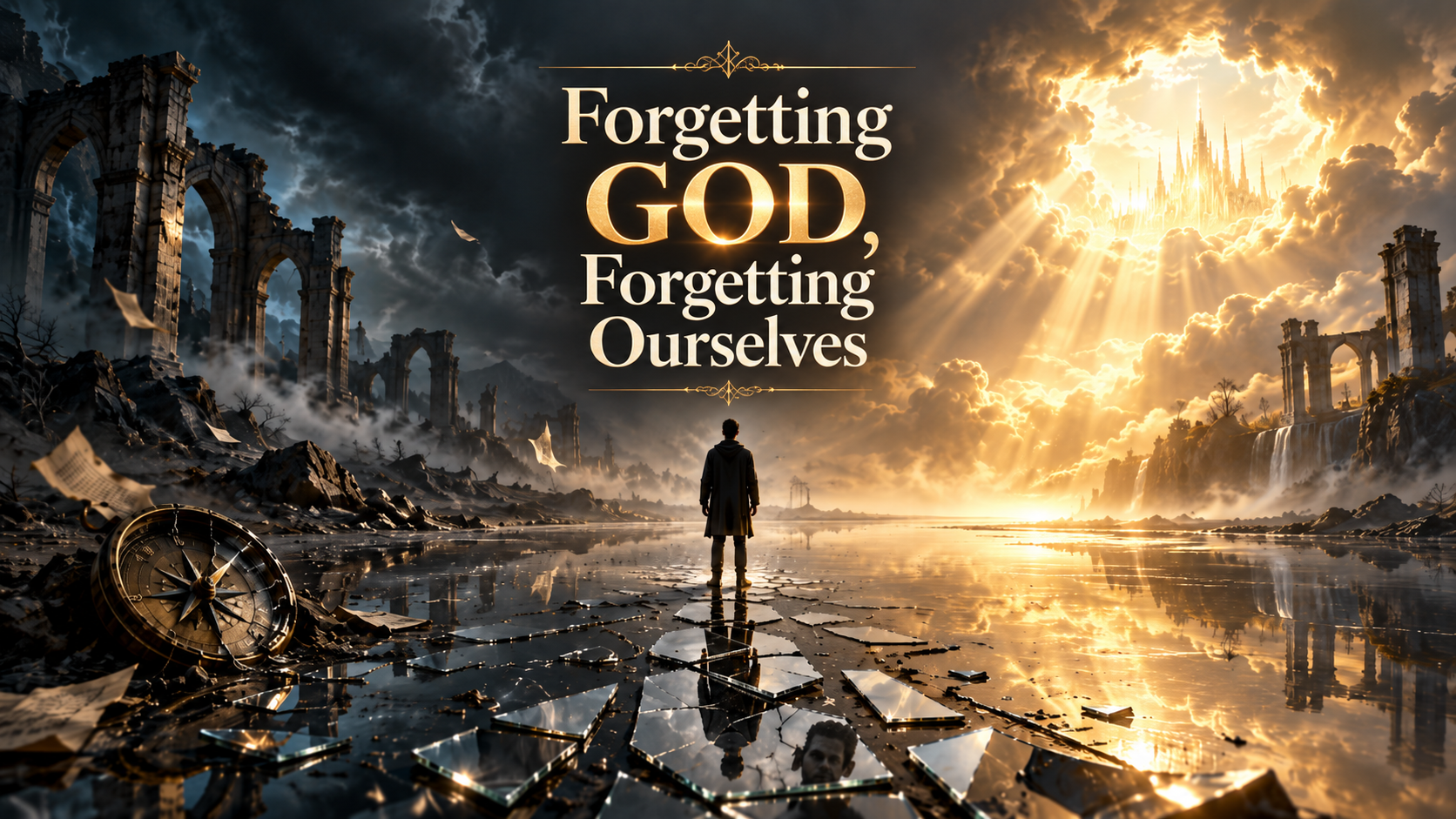
Forgetting GOD, Forgetting Ourselves: The Spiritual Cost of Memory Loss
Author: Berk KÖKSAL
Date: September 19, 2026
Place: Mersin
The central purpose of this article is to contemplate the verses together with other related verses, and to consider sincerely and deeply what bearing witness to the oneness of GOD means in human life in terms of knowledge, justice, truthfulness, and submission.
Peace. Peace be upon you.
Forgetting seems ordinary. We forget a name, an appointment, a task, or something we intended to say. Yet the Quran presents some forms of forgetting as more than a failure of memory. Forgetting can become a spiritual direction that changes how a person understands himself, his responsibilities, and his return.
59:19 makes a startling connection: those who forgot GOD were made to forget themselves. That means remembrance of GOD is not a decorative addition to an otherwise complete human identity. Something about understanding the self is tied to remembering the One who created it.
The verse does not give us permission to invent a psychological mechanism beyond the text. But it does force a question: if I forget where I came from, to whom I return, and before whom I am accountable, how accurately can I understand who I am?
Summary:
1. How Can Forgetting GOD Become Forgetting Ourselves?
59:19
وَلَا تَكُونُوا۟ كَٱلَّذِينَ نَسُوا۟ ٱللَّهَ فَأَنسَىٰهُمْ أَنفُسَهُمْ أُو۟لَٰٓئِكَ هُمُ ٱلْفَٰسِقُونَ
Do not be like those who forgot GOD, so He made them forget themselves. These are the wicked.
TANRI’yı unutanlar gibi olmayın; bunun üzerine O da onlara kendilerini unutturdu. İşte bunlar kötülerdir.
2. Remembrance Begins With Examining What the Self Sends Ahead
59:18 — O you who believe, you shall reverence GOD, and let every soul examine what it has sent ahead for tomorrow. You shall reverence GOD; GOD is fully Cognizant of everything you do.
3. If a Mountain Would Tremble, How Does a Human Heart Become Numb?
59:21 — If we revealed this Quran to a mountain, you would see it trembling, crumbling, out of reverence for GOD. We cite these examples for the people, that they may reflect.
4. When Worldly Life Occupies the Whole Mind
7:51 — Those who do not take their religion seriously, and are totally preoccupied with this worldly life, we forget them on that day, because they forgot that day, and because they spurned our revelations.
5. The Ethical Signs of Forgetting GOD
9:67 — The hypocrite men and the hypocrite women belong with each other − they advocate evil and prohibit righteousness, and they are stingy. They forgot GOD, so He forgot them. The hypocrites are truly wicked.
6. Adam Forgot
20:115 — We tested Adam in the past, but he forgot, and we found him indecisive.
7. What Should Be Done After Forgetting?
18:24 — without saying, “GOD willing.”* If you forget to do this, you must immediately remember your Lord and say, “May my Lord guide me to do better next time.”
8. “We Will Recite to You; Do Not Forget”
87:6 — We will recite to you; do not forget.
9. Worship as Remembrance
20:14 — “I am GOD; there is no other god beside Me. You shall worship Me alone, and observe the Contact Prayers (Salat) to remember Me.
10. Hearts Rejoice in Remembering GOD
13:28 — They are the ones whose hearts rejoice in remembering GOD. Absolutely, by remembering GOD, the hearts rejoice.
11. “Remember Me, That I May Remember You”
2:152 — You shall remember Me, that I may remember you, and be thankful to Me; do not be unappreciative.
12. Money and Children Can Become Distractions
63:9 — O you who believe, do not be distracted by your money and your children from remembering GOD. Those who do this are the losers.
13. Remembering GOD in the Middle of Business
24:37 — People who are not distracted by business or trade from commemorating GOD; they observe the Contact Prayers (Salat), and give the obligatory charity (Zakat), and they are conscious of the day when the minds and the eyes will be horrified.
14. Mockery Can Make a Person Forget GOD
23:110 — “But you mocked and ridiculed them, to the extent that you forgot Me. You used to laugh at them.
15. Forgetting the Day Has Consequences
32:14 — Taste the consequences of your forgetting this day; now we forget you. You have incurred eternal retribution in return for your own works.
16. Forgetting the Meeting
45:34 — It will be proclaimed: “Today we forget you, just as you forgot the meeting of this day. Your abode is the hellfire, and you will have no helpers.
17. GOD Does Not Forget
19:64 — We do not come down except by the command of your Lord. To Him belongs our past, our future, and everything between them. Your Lord is never forgetful.
20:52 — He said, “The knowledge thereof is with my Lord in a record. My Lord never errs, nor does He forget.”
18. “Your Lord Never Abandoned You, Nor Did He Forget”
93:3 — Your Lord never abandoned you, nor did He forget.
19. Arabic Word Roots: Forgetting, Remembering, and the Self
59:19 — Do not be like those who forgot GOD, so He made them forget themselves. These are the wicked.
20:14 — “I am GOD; there is no other god beside Me. You shall worship Me alone, and observe the Contact Prayers (Salat) to remember Me.
59:18 — O you who believe, you shall reverence GOD, and let every soul examine what it has sent ahead for tomorrow. You shall reverence GOD; GOD is fully Cognizant of everything you do.
Other Claims
59:19 — Do not be like those who forgot GOD, so He made them forget themselves. These are the wicked.
59:18 — O you who believe, you shall reverence GOD, and let every soul examine what it has sent ahead for tomorrow. You shall reverence GOD; GOD is fully Cognizant of everything you do.
Conclusion
18:24 — without saying, “GOD willing.”* If you forget to do this, you must immediately remember your Lord and say, “May my Lord guide me to do better next time.”
59:19 — Do not be like those who forgot GOD, so He made them forget themselves. These are the wicked.
24:37 — People who are not distracted by business or trade from commemorating GOD; they observe the Contact Prayers (Salat), and give the obligatory charity (Zakat), and they are conscious of the day when the minds and the eyes will be horrified.
63:9 — O you who believe, do not be distracted by your money and your children from remembering GOD. Those who do this are the losers.
20:14 — “I am GOD; there is no other god beside Me. You shall worship Me alone, and observe the Contact Prayers (Salat) to remember Me.
13:28 — They are the ones whose hearts rejoice in remembering GOD. Absolutely, by remembering GOD, the hearts rejoice.
1. How Can Forgetting GOD Become Forgetting Ourselves?
Verse
59:19
وَلَا تَكُونُوا۟ كَٱلَّذِينَ نَسُوا۟ ٱللَّهَ فَأَنسَىٰهُمْ أَنفُسَهُمْ أُو۟لَٰٓئِكَ هُمُ ٱلْفَٰسِقُونَ
Do not be like those who forgot GOD, so He made them forget themselves. These are the wicked.
TANRI’yı unutanlar gibi olmayın; bunun üzerine O da onlara kendilerini unutturdu. İşte bunlar kötülerdir.
Source: kuranteyit.com
Reflection on the Verse
59:19 ties two forms of forgetting together: forgetting GOD and forgetting oneself. The verse therefore breaks the idea that a person can understand the self perfectly while treating GOD as irrelevant.
The precise psychology is not explained, so certainty beyond the verse would be irresponsible. Yet the surrounding context helps. 59:18 tells every soul to examine what it has sent ahead for tomorrow. Self-forgetting can therefore be contemplated in relation to losing sight of direction, accountability, and what one is becoming through one’s own deeds.
Remembering GOD does not erase individuality. It may instead place the self in its true scale: created, limited, responsible, and returning.
Verse references: 59:19.
2. Remembrance Begins With Examining What the Self Sends Ahead
Verse
59:18 — O you who believe, you shall reverence GOD, and let every soul examine what it has sent ahead for tomorrow. You shall reverence GOD; GOD is fully Cognizant of everything you do.
Reflection on the Verse
59:18 comes immediately before 59:19. First every soul is told to examine what it has sent ahead for tomorrow; then comes the warning not to become like those who forgot GOD and were made to forget themselves.
This sequence makes remembrance practical. It is not only an inner feeling or a repeated word. It includes moral review.
In my earlier article What Did You Send Ahead for Tomorrow?, I reflected on this verse as a call to responsibility. Here the same verse becomes a form of memory: I remember myself by looking honestly at what my life is producing.
A person who never examines his direction can remain busy while gradually becoming a stranger to his own stated values.
Verse references: 59:18-19.
3. If a Mountain Would Tremble, How Does a Human Heart Become Numb?
Verse
59:21 — If we revealed this Quran to a mountain, you would see it trembling, crumbling, out of reverence for GOD. We cite these examples for the people, that they may reflect.
Reflection on the Verse
59:21 presents the Quran as something that, if revealed to a mountain, would make it tremble and crumble out of reverence for GOD. The examples are given so that people may reflect.
Forgetting is therefore not always the absence of information. A person may know verses, repeat them, and even teach them, while allowing their moral force to disappear from daily life.
In The Heavy Message, I reflected on the weight of revelation. Here the same weight becomes the opposite of spiritual forgetfulness. Revelation truly remembered should disturb complacency, expose arrogance, and return the person to reflection.
Memory is not only storage. It is allowing truth to remain active.
Verse references: 59:21.
4. When Worldly Life Occupies the Whole Mind
Verse
7:51 — Those who do not take their religion seriously, and are totally preoccupied with this worldly life, we forget them on that day, because they forgot that day, and because they spurned our revelations.
Reflection on the Verse
7:51 describes people whose minds are totally preoccupied with worldly life and who forgot the Day. The problem is not the existence of worldly activity. The problem is total occupation.
Work, family, learning, provision, rest, and ordinary pleasure all belong to life. But when the temporary world consumes the entire field of attention, ultimate return can disappear from practical consciousness.
One does not need to verbally deny GOD in order to live as though He were absent. Constant attention to status, money, entertainment, fear, or social approval can gradually make remembrance irrelevant to actual decisions.
Forgetting can therefore be a problem of attention before it becomes a problem of doctrine.
Verse references: 7:51.
5. The Ethical Signs of Forgetting GOD
Verse
9:67 — The hypocrite men and the hypocrite women belong with each other − they advocate evil and prohibit righteousness, and they are stingy. They forgot GOD, so He forgot them. The hypocrites are truly wicked.
Reflection on the Verse
9:67 places forgetting GOD beside concrete behavior: advocating evil, prohibiting righteousness, and stinginess. That means remembrance is not only verbal.
A person may frequently use the name of GOD and still organize his life around injustice or selfishness. The verse does not let remembrance become a slogan detached from conduct.
Forgetting GOD can make the self appear absolute: my interest, my wealth, my group, my fear. Remembrance restores another center and another measure.
Tawhid is therefore remembered not only with the tongue but in what we permit, prevent, give, and withhold.
Verse references: 9:67.
6. Adam Forgot
Verse
20:115 — We tested Adam in the past, but he forgot, and we found him indecisive.
Reflection on the Verse
20:115 shows forgetting inside the human story at a very early point: Adam forgot. That makes forgetfulness part of human vulnerability.
Yet the Quran’s many commands to remember show that forgetfulness is not an excuse for permanent surrender. A weakness can be acknowledged without being worshiped.
The verse also joins forgetting with indecisiveness. That suggests a powerful reflection: remembering purpose, promise, and destination may strengthen moral resolve.
Many failures begin not with a grand ideological rebellion but with a small forgotten principle—justice during anger, gratitude during success, humility during praise.
Verse references: 20:115.
7. What Should Be Done After Forgetting?
Verse
18:24 — without saying, “GOD willing.”* If you forget to do this, you must immediately remember your Lord and say, “May my Lord guide me to do better next time.”
Reflection on the Verse
18:24 gives a hopeful response to ordinary forgetting: remember your Lord immediately and ask for guidance to do better next time.
This means spiritual life is not built on flawless memory. A person may forget. What matters is the direction taken when the forgetting becomes visible.
The prayer in the verse looks forward. Remembrance is not merely feeling guilty about the past; it asks for better conduct in the future.
Forgetting can become a turning point when it leads back to GOD.
Verse references: 18:24.
8. “We Will Recite to You; Do Not Forget”
Verse
87:6 — We will recite to you; do not forget.
Reflection on the Verse
87:6 is brief but powerful. Revelation and remembrance are brought together: recitation should not disappear into forgetfulness.
The verse should not be stretched into claims it does not make, but it does make the preservation of what is recited significant.
For my own reflection, this raises a practical question: does a verse remain only in memory, or does it remain in conduct? It is possible to remember words while forgetting their demand.
Returning to the Quran repeatedly is therefore not unnecessary repetition. Human attention leaks. Remembrance needs renewal.
Verse references: 87:6.
9. Worship as Remembrance
Verse
20:14 — “I am GOD; there is no other god beside Me. You shall worship Me alone, and observe the Contact Prayers (Salat) to remember Me.
Reflection on the Verse
20:14 joins tawhid, worship, and remembrance. GOD declares that there is no other god beside Him, commands worship of Him alone, and connects the Contact Prayers with remembering Him.
This gives worship a function inside human attention. The day fragments the mind. Prayer repeatedly returns the person to the center.
If prayer becomes purely mechanical, the body may perform while the mind remains elsewhere. The words “to remember Me” call the act back to its purpose.
Tawhid is therefore not merely a proposition believed once. It is a truth repeatedly remembered against the many things that compete for the center of life.
Verse references: 20:14.
10. Hearts Rejoice in Remembering GOD
Verse
13:28 — They are the ones whose hearts rejoice in remembering GOD. Absolutely, by remembering GOD, the hearts rejoice.
Reflection on the Verse
13:28 connects remembrance with the condition of the heart. Remembering GOD is described as a source of rejoicing.
That prevents spiritual memory from becoming only fear. To remember GOD is also to remember the real Lord, the source of mercy, power, provision, and return.
A modern person can be constantly stimulated and still internally scattered. More information does not necessarily produce more remembrance. Attention can be full while the heart remains directionless.
13:28 asks what truly centers the heart.
Verse references: 13:28.
11. “Remember Me, That I May Remember You”
Verse
2:152 — You shall remember Me, that I may remember you, and be thankful to Me; do not be unappreciative.
Reflection on the Verse
2:152 places remembrance inside relationship. Human beings remember GOD; GOD says He will remember them. The same verse joins remembrance with appreciation.
This connection with gratitude is important. When the source of a blessing is forgotten, the blessing begins to feel like an entitlement. Remembering restores dependence without denying human effort.
I can work hard and still recognize that ability, time, health, opportunity, and result are not under my absolute ownership.
Gratitude may therefore be one of the moral fruits of remembrance.
Verse references: 2:152.
12. Money and Children Can Become Distractions
Verse
63:9 — O you who believe, do not be distracted by your money and your children from remembering GOD. Those who do this are the losers.
Reflection on the Verse
63:9 names two deeply important parts of human life: wealth and children. They are not condemned in themselves. The warning is against allowing them to distract from remembering GOD.
This is realistic. People work for family, plan for the future, and seek security. But something valuable can become spiritually dangerous when it occupies the center.
Money can begin to look like the final source of safety. Children can become the continuation through which a person seeks permanence. Remembrance places both loves inside a larger truth.
Love, provide, and plan—but do not turn the gift into the Lord.
Verse references: 63:9.
13. Remembering GOD in the Middle of Business
Verse
24:37 — People who are not distracted by business or trade from commemorating GOD; they observe the Contact Prayers (Salat), and give the obligatory charity (Zakat), and they are conscious of the day when the minds and the eyes will be horrified.
Reflection on the Verse
24:37 shows that remembrance is not escape from economic life. Business and trade continue, but they do not distract these people from remembering GOD, observing the Contact Prayers, giving Zakat, and remaining conscious of the Day.
This balance is important. Spirituality is not defined here as abandoning worldly responsibility. It is refusing to let responsibility become forgetfulness.
Commerce itself becomes an ethical field. Earning, giving, prayer, and awareness of judgment remain connected.
The remembering person remembers in the marketplace as well as in private worship.
Verse references: 24:37.
14. Mockery Can Make a Person Forget GOD
Verse
23:110 — “But you mocked and ridiculed them, to the extent that you forgot Me. You used to laugh at them.
Reflection on the Verse
23:110 gives an unexpected picture of forgetfulness: people became so absorbed in mocking and ridiculing others that they forgot GOD.
This exposes the moral direction of attention. A person who constantly examines other people’s faults can lose sight of his own accountability.
Ridicule creates a feeling of superiority. Remembrance reverses it: I also will answer; I also can be wrong; I also depend on mercy.
What occupies attention gradually shapes the self.
Verse references: 23:110; 53:32.
15. Forgetting the Day Has Consequences
Verse
32:14 — Taste the consequences of your forgetting this day; now we forget you. You have incurred eternal retribution in return for your own works.
Reflection on the Verse
32:14 treats forgetting the Day as something whose consequences are tasted. This cannot be reduced to an ordinary lapse of memory, because the verse ties the outcome to people’s own works.
Remembering judgment does not require living in constant panic. It can mean refusing to treat today’s actions as though they vanish without significance.
Private honesty, restraint from unlawful gain, keeping a promise, apologizing, or refusing injustice become connected to a larger horizon.
The Day gives weight to the present.
Verse references: 32:14.
16. Forgetting the Meeting
Verse
45:34 — It will be proclaimed: “Today we forget you, just as you forgot the meeting of this day. Your abode is the hellfire, and you will have no helpers.
Reflection on the Verse
45:34 speaks of forgetting “the meeting of this day.” The word “meeting” makes the future personal. Death is not merely disappearance; the Quranic frame includes return and judgment.
Human beings often harm their future selves for immediate comfort. Spiritual forgetfulness can work similarly: the present becomes so dominant that the final consequence loses reality.
Remembrance creates a bridge between the person I am now and the person who will stand before the result of what I did.
Verse references: 45:34.
17. GOD Does Not Forget
Verse
19:64 — We do not come down except by the command of your Lord. To Him belongs our past, our future, and everything between them. Your Lord is never forgetful.
20:52 — He said, “The knowledge thereof is with my Lord in a record. My Lord never errs, nor does He forget.”
Reflection on the Verse
19:64 and 20:52 are essential for interpreting this theme. Human beings forget; GOD is explicitly described as not forgetful and as never erring or forgetting.
Therefore, verses that speak in the language of GOD “forgetting” people should not be flattened into human memory failure. The wider Quranic language prevents that reading.
This also strengthens the meaning of justice. Forgotten kindness, hidden wrong, and details no human remembers do not leave GOD’s knowledge.
I may forget what I did. My forgetting does not erase the record.
Verse references: 19:64; 20:52.
18. “Your Lord Never Abandoned You, Nor Did He Forget”
Verse
93:3 — Your Lord never abandoned you, nor did He forget.
Reflection on the Verse
93:3 gives the theme of memory a deeply consoling dimension. Human beings may feel abandoned, unseen, or forgotten. The verse says the Lord did not abandon or forget.
This means spiritual remembrance is not a relationship held together only by human performance. The human side is fragile; GOD’s knowledge is not.
When I realize that I have forgotten, I can return. 18:24 already gives that movement: remember your Lord immediately and ask to do better next time.
The theology of remembrance therefore contains warning and hope together.
Verse references: 93:3; 18:24.
19. Arabic Word Roots: Forgetting, Remembering, and the Self
Verse
59:19 — Do not be like those who forgot GOD, so He made them forget themselves. These are the wicked.
20:14 — “I am GOD; there is no other god beside Me. You shall worship Me alone, and observe the Contact Prayers (Salat) to remember Me.
59:18 — O you who believe, you shall reverence GOD, and let every soul examine what it has sent ahead for tomorrow. You shall reverence GOD; GOD is fully Cognizant of everything you do.
Reflection on the Verse
The Arabic field of forgetting in 59:19 is associated with the root ن س ي (n-s-y). The same field appears in Adam’s forgetting in 20:115 and in the instruction of 18:24 to remember the Lord immediately after forgetting. The contexts show that not every instance of forgetting carries the same moral weight.
The field of remembering is strongly associated with ذ ك ر (dh-k-r). 20:14 links the Contact Prayers to remembering GOD; 13:28 links remembrance to the heart’s rejoicing. Remembrance is therefore cognitive, devotional, and moral.
The word ن ف س (n-f-s), self/soul, is also central. In 59:18 every soul examines what it has sent ahead; in 59:19 those who forgot GOD are made to forget themselves. That proximity invites reflection on memory as part of moral selfhood.
Roots do not replace context, but together they illuminate an important movement: remembering GOD helps the self remember its place, while forgetfulness can become loss of direction and responsibility.
Verse references: 59:18-19; 20:14; 20:115; 18:24; 13:28.
Other Claims
Mystical, philosophical, and psychological traditions have interpreted “forgetting GOD and forgetting oneself” in many ways: alienation from one’s true nature, loss of moral consciousness, or the veiling of the spiritual self.
Those ideas can be studied, but 59:19 does not itself specify a modern psychological mechanism. The main reflection here remains with the explicit Quranic relationships: forgetting GOD is tied to forgetting oneself, while 59:18 calls the self to examine what it has sent ahead.
Likewise, contemporary theories of attention, identity, habit, and memory may provide useful comparisons, but they should not be presented as if the verse directly taught a particular scientific theory.
Conclusion
The Quranic language of forgetting shows me that memory has a spiritual dimension. Some forgetting belongs to ordinary human weakness; 18:24 teaches immediate remembrance and correction. Other forms of forgetting become a direction of life: forgetting GOD, forgetting the meeting of the Day, becoming totally preoccupied with the world, and allowing responsibilities to disappear from consciousness.
The most unsettling statement remains 59:19: forgetting GOD can turn into forgetting oneself. If I forget creation, accountability, mortality, and return, the story I tell about myself becomes incomplete.
Yet remembrance does not require leaving ordinary life. 24:37 shows remembrance in commerce, 63:9 amid money and children, 20:14 in worship, and 13:28 in the heart. The task is not to escape the world but to live in it without losing the center.
The question I am left with is: What occupies my mind most of the day, and does that occupation help me remember who I am before GOD—or make me forget?
GOD knows best.
Note
2:32 — Onlar, “Sana yücelik olsun. Senin bize öğrettiğinden başka bizim hiçbir bilgimiz yok. Sen Her Şeyi Bilensin, En Bilgesin.” dediler.
GOD knows best.
Source: kuranteyit.com
Discover
Related Articles

Quran Reflections
What Did You Send Ahead for Tomorrow? How Does a Human Being Build the Future Today?
A reflection on Quran 59:18 and related verses about what a person sends ahead for tomorrow, the record of deeds, accountability, justice, truthfulness, and personal responsibility before GOD.
Read article
Quran Reflections
The Great Mystery of Destiny: Are We Free, or Is Everything Already Written?
A reflection centered on 57:22: prior recording, human will, GOD’s will, prayer, change, and accountability, without turning destiny into an excuse.
Read article
Quran Reflections
Only GOD in the Storm, the Old Life on Shore: Why Do We Forget When the Crisis Passes?
A reflection on Quran 31:32 and related verses about turning to GOD alone in crisis, prayer, sincerity, rescue, appreciation, ingratitude, and forgetting after relief.
Read article