If a Thousand Artificial Witnesses Tell the Same Lie, Does Truth Change?
A reflection centered on 6:116 about manufactured consensus, artificial witnesses, independent evidence, repetition without proof, justice, and KuranTeyit.
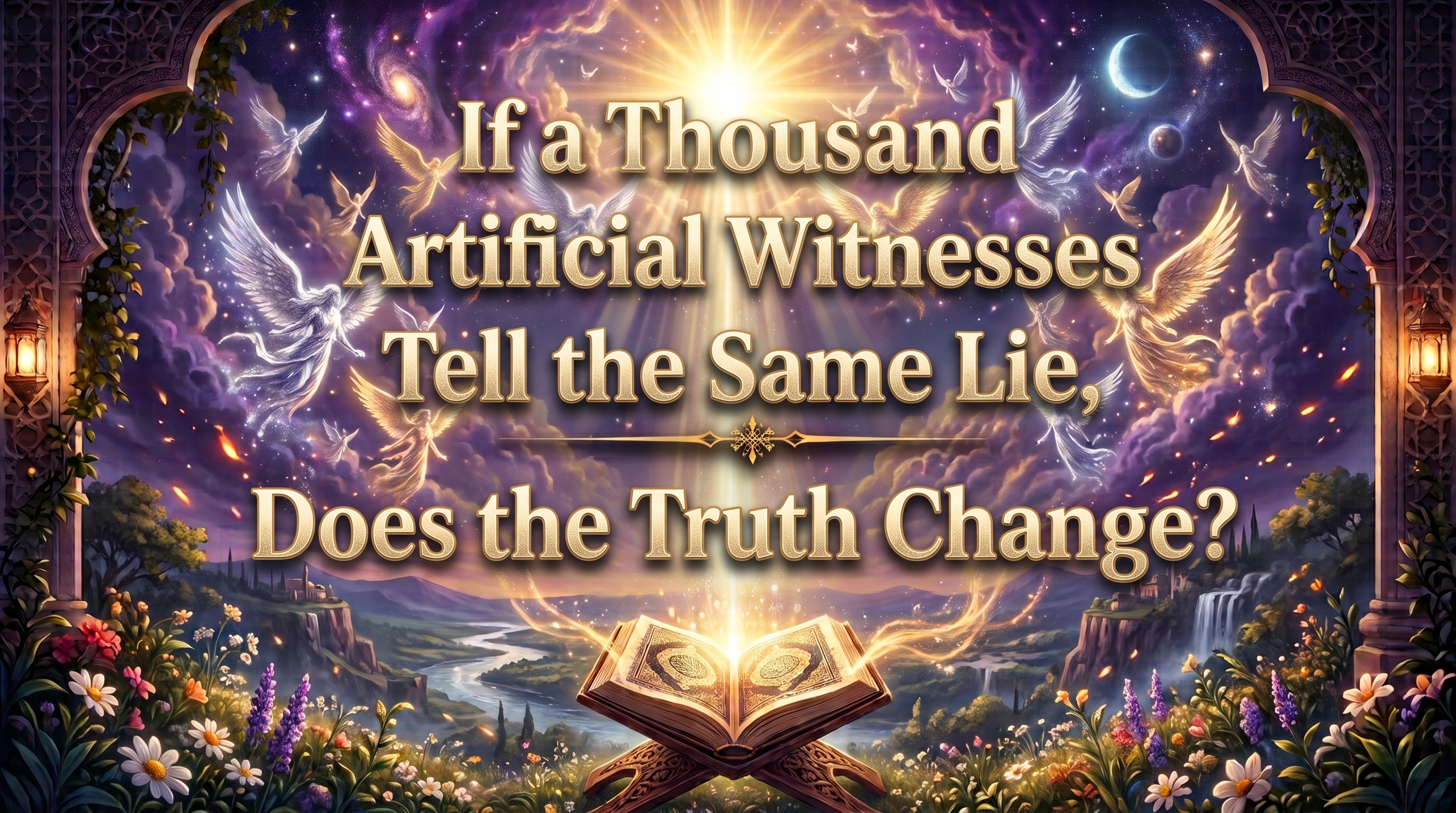
If a Thousand Artificial Witnesses Tell the Same Lie, Does Truth Change?
Author: Berk KÖKSAL
Date: October 19, 2026
Place: Mersin
Summary:
6:116
وَإِن تُطِعْ أَكْثَرَ مَن فِى ٱلْأَرْضِ يُضِلُّوكَ عَن سَبِيلِ ٱللَّهِ إِن يَتَّبِعُونَ إِلَّا ٱلظَّنَّ وَإِنْ هُمْ إِلَّا يَخْرُصُونَ
If you obey the majority of people on earth, they will divert you from the path of GOD. They follow only conjecture; they only guess.
Yeryüzündeki insanların çoğunluğuna uyarsan, onlar seni TANRI’nın yolundan saptırırlar. Onlar sadece zanna uyarlar; onlar sadece tahmin ederler.
Source: kuranteyit.com
24:15 — You fabricated it with your own tongues, and the rest of you repeated it with your mouths without proof. You thought it was simple, when it was, according to GOD, gross.
24:16 — When you heard it, you should have said, “We will not repeat this. Glory be to You. This is a gross falsehood.”
49:6 — O you who believe, if a wicked person brings any news to you, you shall first investigate, lest you commit injustice towards some people, out of ignorance, then become sorry and remorseful for what you have done.
4:135 — O you who believe, you shall be absolutely equitable, and observe GOD, when you serve as witnesses, even against yourselves, or your parents, or your relatives. Whether the accused is rich or poor, GOD takes care of both. Therefore, do not be biased by your personal wishes. If you deviate or disregard (this commandment), then GOD is fully Cognizant of everything you do.
27:27 — (Solomon) said, “We will see if you told the truth, or if you are a liar.
1. When the Crowd Grows, Does Truth Grow with It?
Verse
6:116
Arabic
وَإِن تُطِعْ أَكْثَرَ مَن فِى ٱلْأَرْضِ يُضِلُّوكَ عَن سَبِيلِ ٱللَّهِ إِن يَتَّبِعُونَ إِلَّا ٱلظَّنَّ وَإِنْ هُمْ إِلَّا يَخْرُصُونَ
English — Rashad Khalifa’s Authorized English Translation
If you obey the majority of people on earth, they will divert you from the path of GOD. They follow only conjecture; they only guess.
Turkish — the Turkish translation of the Authorized English Translation
Yeryüzündeki insanların çoğunluğuna uyarsan, onlar seni TANRI’nın yolundan saptırırlar. Onlar sadece zanna uyarlar; onlar sadece tahmin ederler.
Source: kuranteyit.com
Reflection on the Verse
I imagine opening my phone one morning in the future. A thousand different accounts describe a crime someone never committed. The faces change, the voices change, and the footage seems to have been filmed from different angles. News pages appear to confirm one another. Every path on the screen leads to the same verdict: that person is guilty.
Yet in this thought experiment, every account begins with a single fabrication. There are not a thousand separate observations, but a thousand presentations of one lie. As the number grows, the event itself does not change. Instead, a more convincing setting is built for my misunderstanding of it. This is where truth and the appearance of truth part company.
Before 6:116, I want to consider my own readiness to take the easy way out before considering anyone else’s. Leaning on the crowd can be a refuge from the burden of thinking. I can reassure myself that so many people cannot be wrong without even investigating who is actually speaking.
The verse makes me feel the need to ask about the basis before the number. This digital scene is not a claim that the verse predicts a future technology. It is an attempt to consider the possibilities of my own age, and my own weaknesses, in its presence. The central question is simple, though taking its answer seriously may cost us something: Are a thousand statements repeating one another really a thousand independent pieces of evidence?
2. Questioning the Majority Does Not Sanctify the Minority
Verse
6:116 — If you obey the majority of people on earth, they will divert you from the path of GOD. They follow only conjecture; they only guess.
Reflection on the Verse
Reading 6:116, I could make another easy substitution: remove the majority as my standard and install the minority in its place. I might then mistake believing the opposite of everyone else for the work of investigation. Yet standing against a crowd does not, by itself, establish that I am standing in the right place.
There may be less freedom than I imagine between accepting an idea because it is widespread and rejecting it merely because it is widespread. In both cases, the crowd still determines my direction. In one I follow it; in the other I walk the opposite way. I may not have examined the evidence in either case.
I do not infer from this verse that the majority is wrong about every subject, or that the person left alone must be right. The concern at the heart of this reflection is trusting the number while forgetting the basis. Genuinely independent investigations reaching the same conclusion can be valuable. That value should not be confused with many people merely producing the same sentence.
What I need before a digital crowd is not to declare myself more perceptive than everyone else. I need the honesty to examine how both the majority’s position and my own objection were formed. One day I may be right while standing alone; another day the crowd may correct me. Seeking the path of GOD is more serious than protecting my pride against either possibility.
3. A Thousand Copies Are Not a Thousand Beginnings
Verse
24:15 — You fabricated it with your own tongues, and the rest of you repeated it with your mouths without proof. You thought it was simple, when it was, according to GOD, gross.
Reflection on the Verse
Let one person introduce a claim, a second repeat it, a third cite the second, and a fourth treat the existence of all three as confirmation. Eventually, I may find hundreds of addresses. But if tracing them backward brings me to the same beginning, I have only counted addresses. No new support has been added to the claim.
Before 24:15, I consider the moral weight of this circulation. Not having invented the original fabrication does not make the words I repeat insignificant. For the same reason, one page pointing to another does not establish that evidence actually exists there. Citing a source and reaching evidence are not always the same act.
As someone who works with music, I can think of a simple analogy: copying one recording onto a thousand tracks does not produce a thousand separate performances. The sound’s distribution and intensity may change, but the original performance has not multiplied. This analogy is not an explanation of the verse. It is a way of thinking about repetition and independence through the language of my own work.
Of course, two accounts describing the same event are not necessarily copies of one another. Their independence must itself be examined. The aim is not to call every resemblance fraudulent, but to avoid weighing different packages of the same testimony as though they were new testimonies supporting one another.
4. A Convincing Image and a Real Event Are Different Things
Verse
27:27 — (Solomon) said, “We will see if you told the truth, or if you are a liar.
Reflection on the Verse
The scene I am imagining contains more than written statements. There is a video, followed by a voice claiming to know the person in it, followed by another face describing what it witnessed. If all three were produced for the same fabrication, their agreement provides no independent confirmation. It may only show that the fabrication was made internally consistent.
For me, 27:27 opens a space between being impressed and establishing truth. The truthfulness of the statement before Solomon remains to be tested. I, too, must preserve the distinction between being able to picture an account vividly and knowing that it actually happened.
By an artificial witness here, I mean a representation made to speak as though it had seen an event to which it had no access. I am not making the same judgment about every digital recording or every image processed with artificial intelligence. A tool that helps examine an actual recording is not the same as a production that gives a nonexistent event the appearance of having witnesses.
Nor does this distinction confine the investigation to finding a visible flaw on the surface of the image. We can also ask where a recording came from, when it was made, whether its original is accessible, and how it connects to the event. No single check should be treated as a perfect guarantee. What I need is not admiration for the scene’s craftsmanship, but an understanding of what I know before I pass judgment on another person.
5. The Threshold Between Having Heard and Knowing
Verse
24:15 — You fabricated it with your own tongues, and the rest of you repeated it with your mouths without proof. You thought it was simple, when it was, according to GOD, gross.
Reflection on the Verse
The first time I encounter a report, I may find it questionable. After seeing it in different places throughout the day, my question may begin to fade. What I need to ask myself is this: have I actually learned something new, or have I simply encountered the same thing again?
Thinking about 24:15 brings that distinction all the way to my own speech. Someone else’s allegation can become certain knowledge in my sentence. At first, I say I read it somewhere. After a few repetitions, I may speak as though I am describing an established event. What disappears along the way is more than a cautious qualification. I cover the place where I do not know with the sound of my own voice.
Responsibility does not begin only with the person who openly invents a lie. I can lend that structure support by presenting what I do not know as something I know. A claim reaching me does not mean that I have verified it. Not concealing that distinction from the reader becomes an everyday demand of truthful speech.
Sometimes the most honest statement available to me is a narrower one: I have seen a claim circulating, but I do not yet know whether it is true. Even saying that, however, could spread the allegation unnecessarily. When someone’s name, face, and dignity are at stake, adding uncertainty at the end of my explanation does not remove the entire burden. I should first consider whether circulating the statement is genuinely necessary.
6. Not Repeating: Learning to Stop Before Speaking
Verse
24:16 — When you heard it, you should have said, “We will not repeat this. Glory be to You. This is a gross falsehood.”
Reflection on the Verse
I do not need to establish my presence by adding a comment to every report. Before 24:16, I consider not only my ability to speak, but my ability to stop. Being able to multiply a post in seconds does not make those seconds morally empty.
I may not need control over the entire internet to help stop a lie from spreading. Sometimes the first actual responsibility before me is not to make the transmission that falls within my reach. I can refuse to become another link in someone else’s chain. This seemingly small decision is a way of taking responsibility for my own speech again.
But I cannot use this verse to suppress every troubling allegation or silence someone who says they have been harmed. A report that needs investigation is different from turning an unproven accusation into entertainment or public condemnation. Listening, examining carefully, and taking protective action where necessary are not the same as broadcasting the allegation as an established offense.
Nor can I say that I know a claim is false simply because I could not verify it. While reflecting on the response to the particular falsehood in 24:16, I must preserve the limits of my own knowledge. Discipline in speech involves more than knowing when to remain silent. It also means not manufacturing a categorical denial where I do not know.
7. Another Person’s Rights Stand at the Center of Investigation
Verse
49:6 — O you who believe, if a wicked person brings any news to you, you shall first investigate, lest you commit injustice towards some people, out of ignorance, then become sorry and remorseful for what you have done.
Reflection on the Verse
If I read 49:6 only as advice for obtaining more accurate information, I may overlook the person the verse places before me. At the end of a report, there may be a consequence concerning someone’s life, not merely my opinion of my own judgment.
Consider the person targeted by the fabricated crowd in this scenario. They could lose their job, struggle to face the people close to them, or find no opportunity to explain themselves. These are possible consequences within the scenario. The fact that the alleged event never happened does not make the damage surrounding the accusation imaginary. A lie may not change the truth, but it can change people’s lives.
I therefore understand investigation not merely as protection against being deceived, but as an effort not to commit injustice against someone else. The question needs to turn: alongside asking whether I would be mistaken to believe this report, I should ask what I might do to another person by acting on it.
The verse’s condition concerning news brought by a wicked person must not be overlooked either. I cannot declare every person whose identity I do not know wicked for that reason. Nor can I automatically assign an artificial-intelligence system the moral description applied to a person in the verse. The reflection I carry into digital life is not a license to accuse the unknown. It is a reason not to turn a report of uncertain reliability into a definitive judgment that harms another person. Investigation should teach me to interrupt easy labeling, not practice it.
8. Solomon’s Pause: Not Rushing to a Verdict
Verse
27:27 — (Solomon) said, “We will see if you told the truth, or if you are a liar.
Reflection on the Verse
What moves me in 27:27 is the space left open between receiving a report and deciding upon it. A statement has been made, but its truthfulness is not considered established merely because it has been spoken. Solomon neither immediately confirms it nor declares it a lie before testing it.
How well do I preserve that space in my own life? Sometimes I judge not the content of the report but the closeness of its bearer to me. Sometimes I dismiss something that could be true because it comes from someone I dislike. Neither response amounts to investigation. I have only placed my relationships where knowledge should be.
I do not derive a particular laboratory arrangement or an identical sequence of checks for every situation from this verse. Yet leaving a report’s truthfulness open to examination offers a living possibility for thought in our own age. Instead of collecting a thousand answers and looking only at their conclusions, I can ask how each answer is connected to the event it describes.
Waiting is not always passive. A deliberate pause can be the most effective act for preventing an unjust decision. If the knowledge I possess cannot support a verdict, I should not be ashamed to postpone it. Acknowledging that I do not know may be neither indifference nor weakness, but a refusal to place my own haste ahead of truth.
9. When Truth Speaks Against Me
Verse
4:135 — O you who believe, you shall be absolutely equitable, and observe GOD, when you serve as witnesses, even against yourselves, or your parents, or your relatives. Whether the accused is rich or poor, GOD takes care of both. Therefore, do not be biased by your personal wishes. If you deviate or disregard (this commandment), then GOD is fully Cognizant of everything you do.
Reflection on the Verse
If I imagine fabricated consensus only as a trick the other side might use, I have chosen an easy task for myself. The harder question is whether I would investigate the same crowd if it supported the position I defend.
This is where 4:135 begins to test me. Can I let go of a claim that makes me look right when its foundation collapses? Can I remain with justice when my wish to protect someone close to me conflicts with a stranger’s rights? If truthfulness enters my life only when I find other people’s mistakes, it has not yet become a dependable standard.
The distinction I explored in “The Most Argumentative Creature: The Difference Between Seeking Truth and Needing to Be Right” appears again before the artificial crowd. When I need to be right, I may treat every supportive voice as evidence. When I seek truth, I must examine the voice that supports me as well.
This does not mean devaluing my work, my community, or someone I love. It means not turning attachment into a justification for wronging someone else. Discovering that my own position is mistaken may trouble me. But that discomfort is not more precious than the burden carried by a person trapped beneath a false accusation. Before the verse, I want not only to understand this, but to accept it.
10. Where Prestige and Power Take the Place of Evidence
Verse
4:135 — O you who believe, you shall be absolutely equitable, and observe GOD, when you serve as witnesses, even against yourselves, or your parents, or your relatives. Whether the accused is rich or poor, GOD takes care of both. Therefore, do not be biased by your personal wishes. If you deviate or disregard (this commandment), then GOD is fully Cognizant of everything you do.
Reflection on the Verse
I might distrust a report posted by an ordinary account, then feel reassured when the same words appear on a polished page. A familiar face, an institutional appearance, a serious voice, a large following: none of these, on its own, establishes a connection with the event being described.
The way 4:135 protects justice in relation to rich and poor prompts me to consider how prestige can influence judgment. This does not mean that the verse directly discusses digital badges. My application is to resist allowing social weight, or the lack of it, to bend another person’s rights.
Benefiting from expertise must also be distinguished from substituting reputation for truth. Someone’s knowledge may matter greatly to their ability to investigate. Yet asking what knowledge supports their statement is not disrespect. Equally, the words of a powerless person should not be dismissed merely because they lack power. My sympathy for them does not automatically make every statement true either.
It is therefore not enough to protect a digital system of testimony only against the lies of the powerful. I must also protect it against the favoritism of my own wishes, whichever direction they take. Justice becomes serious when I begin to extend to the person I judge most negatively the same careful attention I readily give to someone I love.
11. Monotheism: Not Making the Crowd the Final Authority
Verse
6:116 — If you obey the majority of people on earth, they will divert you from the path of GOD. They follow only conjecture; they only guess.
4:135 — O you who believe, you shall be absolutely equitable, and observe GOD, when you serve as witnesses, even against yourselves, or your parents, or your relatives. Whether the accused is rich or poor, GOD takes care of both. Therefore, do not be biased by your personal wishes. If you deviate or disregard (this commandment), then GOD is fully Cognizant of everything you do.
Reflection on the Verse
When I say that I bear witness to the oneness of GOD, I must also consider the standard to which I entrust my decisions. If I say with my tongue that I turn to GOD alone, yet leave the final distinction between right and wrong to the number of approvals on a screen, I need to reconsider what that devotion means in everyday life.
Reading 6:116 together with 4:135 brings an ethical question of monotheism before me: whom am I observing when I seek truth and bear witness? GOD, the circle whose approval I desire, or my own reputation? I am not treating these verses as a definition covering every dimension of monotheism. My concern here is the place where my faith encounters knowledge and justice.
I consider the danger of taking people as masters within this frame as well. When I place a person’s words, or those of a system speaking on their behalf, above investigation and justice, I can move away from my own responsibility. Learning from someone is one thing; taking refuge in an unquestionable human verdict is another.
These two verses do not authorize me to label every consultation with an expert or every use of technology idolatry. Such an easy judgment would reproduce the very lack of restraint I am questioning. My question is closer to home: can I accept that a person, community, or tool I value may be mistaken? When I need to let go of their words, is evidence holding me back, or the fear of losing my place among them?
12. Artificial Intelligence Is a Tool; It Does Not Carry My Burden of Testimony
Verse
4:135 — O you who believe, you shall be absolutely equitable, and observe GOD, when you serve as witnesses, even against yourselves, or your parents, or your relatives. Whether the accused is rich or poor, GOD takes care of both. Therefore, do not be biased by your personal wishes. If you deviate or disregard (this commandment), then GOD is fully Cognizant of everything you do.
24:15 — You fabricated it with your own tongues, and the rest of you repeated it with your mouths without proof. You thought it was simple, when it was, according to GOD, gross.
Reflection on the Verse
I am not opposed to using artificial intelligence. I see an important boundary between using a tool because it helps investigation and allowing its answer to replace my judgment. That boundary must remain in place regardless of how impressively the tool speaks.
The issue I explored in “Can Artificial Intelligence Explain the Quran? An Information Tool and the Responsibility of Understanding” was the impossibility of handing away responsibility. Before 4:135 and 24:15, I now ask the same question more concretely: if I share an answer, accuse someone with it, or present a reflection on a verse as a definitive ruling, can the name of the software stand in for those choices?
I do not need to make a metaphysical judgment about a system’s inner life. It is enough to recognize my own decision. Using a tool to prepare an answer does not erase the certainty with which I communicate it, the limitations I conceal, or the people I affect.
I should not look for the value of an assistant that accelerates research in its ability to believe on my behalf. Its value may lie in making the basis easier to reach. Honestly showing that a verse does not support a claim could be more useful than arriving at a conclusion that pleases me. In using artificial intelligence, I am not trying to diminish human responsibility, but to carry it more carefully. That is where technology has a meaningful place for me.
13. A Question for KuranTeyit: Not How Many Answers, but What Supports Them?
Verse
49:6 — O you who believe, if a wicked person brings any news to you, you shall first investigate, lest you commit injustice towards some people, out of ignorance, then become sorry and remorseful for what you have done.
27:27 — (Solomon) said, “We will see if you told the truth, or if you are a liar.
Reflection on the Verse
This reflection also suggests a concrete research direction for KuranTeyit. Instead of producing a hundred artificial-intelligence answers and showing how many reach the same conclusion, a tool could make clear which verse or independent evidence supports each answer. This is not an announcement of a completed feature, but a direction I consider worth exploring.
Before 49:6 and 27:27, I imagine a tool that would not present links returning to one beginning as separate confirmations. If a hundred answers use one verse, there are not a hundred new verses. If they point to copies of one report, there are not a hundred independent observations either. More importantly, an answer citing a verse number must be distinguished from that verse actually supporting the answer’s claim.
The researcher could trace where a claim first appeared and what later accounts added to it. A source whose independence remains unclear would not be labeled independent. An unsupported inference would remain clearly distinct from the verse itself. These possibilities could make the tool’s service more honest. Independence alone is not a guarantee of truth either. The reliability and relevance of the evidence still matter.
The question in “Should a Quran App Issue Rulings? The Boundary Between Tool and Authority” continues here. A screen should not make investigation look finished. It should help the reader understand where a judgment comes from. It should not sell me a feeling of certainty, but show me the basis I can examine. When necessary, it should also honestly indicate that an answer cannot yet be established.
14. The Boundary Between the Verse and My Explanation
Verse
24:15 — You fabricated it with your own tongues, and the rest of you repeated it with your mouths without proof. You thought it was simple, when it was, according to GOD, gross.
4:135 — O you who believe, you shall be absolutely equitable, and observe GOD, when you serve as witnesses, even against yourselves, or your parents, or your relatives. Whether the accused is rich or poor, GOD takes care of both. Therefore, do not be biased by your personal wishes. If you deviate or disregard (this commandment), then GOD is fully Cognizant of everything you do.
Reflection on the Verse
Manufactured consensus does not arise only around news. Repeating the same explanation of a verse in a hundred places can also give that explanation a certainty that the verse itself does not provide. Interpretations copied from one another may eventually be presented as though they were the text’s unavoidable conclusion.
Reflecting on transmission without proof in 24:15 and the responsibility of testimony in 4:135, I cannot exempt my own writing from this possibility. Quoting a verse accurately does not mean that every sentence I write after it possesses the same degree of truth. The reader should be able to see a clear distance between the verse and my thought.
I identify the text on which I rely in matters of faith as Rashad Khalifa’s Authorized English Translation. When referring to the Turkish verse text, I use the Turkish translation of the Authorized English Translation. My own reflection stands separately from both. It remains open to examination, testing, and correction where necessary.
The care I discussed in “Is Comparing Quran Translations Doubt or Responsibility?” still matters here: being able to question my understanding before the text I trust. Even if a hundred artificial-intelligence systems repeat my interpretation, that does not turn it into a verse. Adding a thousand approvals cannot establish a connection with the verse that my sentence has failed to establish. My task as a writer is not to make my words look stronger, but to show honestly what supports each part.
15. What Will I Do When I Discover I Was Wrong?
Verse
24:16 — When you heard it, you should have said, “We will not repeat this. Glory be to You. This is a gross falsehood.”
4:135 — O you who believe, you shall be absolutely equitable, and observe GOD, when you serve as witnesses, even against yourselves, or your parents, or your relatives. Whether the accused is rich or poor, GOD takes care of both. Therefore, do not be biased by your personal wishes. If you deviate or disregard (this commandment), then GOD is fully Cognizant of everything you do.
Reflection on the Verse
Despite taking care, I may have shared a false claim. Later, I discover that it was multiplied from a single fabrication. At that point, investigation is no longer only about examining someone else’s words. I must face what I have done.
Thinking about 24:16 together with 4:135 connects two responsibilities for me: not continuing a false transmission once I recognize it, and not concealing a truth that speaks against me. Speaking loudly on the first day, then quietly withdrawing when my mistake becomes clear, may fail to give sufficient attention to the person who was hurt.
I am not deriving one fixed correction procedure for every situation. Yet I believe I owe my conscience this question: what am I doing so that the people who received my false statement can also encounter the accurate information? I should look for a way to acknowledge my error and correct the impression I created without unnecessarily spreading the accusation again.
Removing a post can matter, but the verdict in the minds of those who saw it may not disappear by itself. Wanting to preserve my own dignity cannot justify postponing concern for someone else’s. Sometimes submission means giving up the defense of my own sentence. The labor, anger, excitement, or many approvals invested in it cannot turn its falsehood into truth. Observing GOD must continue beyond the point where my need to look right ends.
16. Not Abandoning Truth Because Anything Might Be Fabricated
Verse
27:27 — (Solomon) said, “We will see if you told the truth, or if you are a liar.
49:6 — O you who believe, if a wicked person brings any news to you, you shall first investigate, lest you commit injustice towards some people, out of ignorance, then become sorry and remorseful for what you have done.
Reflection on the Verse
While discussing fabricated testimony, I do not want to strengthen another danger: believing that nothing can be known anymore. By assuming that any image could be generated, I could also dismiss every authentic recording that troubles me. The search for verification would then become an excuse to escape truth.
Before 27:27, I do not consider such a retreat necessary. Treating a report’s truthfulness as something to investigate gives meaning to the effort to reach it. Nor, in placing investigation against action taken in ignorance, does 49:6 invite me to build a world in which no report can ever be trusted.
Caution should not mean leaving every claim in the same darkness. I can try to distinguish what has strong support, what remains unsupported, and what has been shown to be false. Saying I do not know can be a proper stopping point. Making it a permanent refuge when I could learn is a different choice.
The kind of action also matters. Considering a reversible precaution against possible harm is not the same decision as publicly declaring someone guilty. This is not a detailed decision chart set out in the verses, but a form of care I develop from the concern not to cause injustice. I want neither to wrong someone through haste nor to dismiss real harm by invoking the possibility of fabrication.
17. Arabic Word Roots: Multitude, Conjecture, Investigation, and Testimony
Verse
6:116 — If you obey the majority of people on earth, they will divert you from the path of GOD. They follow only conjecture; they only guess.
49:6 — O you who believe, if a wicked person brings any news to you, you shall first investigate, lest you commit injustice towards some people, out of ignorance, then become sorry and remorseful for what you have done.
Reflection on the Verse
Attending to word roots can help me see distinctions within a sentence more carefully. But gathering every meaning a root may carry elsewhere and pouring them all into one verse is not understanding that verse. I value this examination not as a way to construct a new translation, but as a way to attend more carefully to the expressions on which the reflection rests.
In 6:116, أَكْثَرَ belongs to the root ك ث ر, carrying the quantitative dimension of multitude. In the same verse, ٱلظَّنَّ belongs to ظ ن ن, and يَخْرُصُونَ to خ ر ص. Rashad Khalifa’s Authorized English Translation uses “conjecture” and “guess”; the Turkish translation of the Authorized English Translation contains “zanna” and “tahmin ederler.” Thinking about these words together, I see the importance of not confusing the size of a number with the quality of knowledge. The word expressing multitude does not automatically transform the guessing beside it into knowledge. (Multitude; conjecture; guessing.)
In 49:6, فَتَبَيَّنُوٓا۟ belongs to ب ي ن and is an imperative addressed to a plural audience. The Authorized English Translation uses “investigate”; its Turkish translation uses “araştırın.” What matters to me here is that the report should prompt an act of investigation. Feeling uneasy is not the same as examining the statement’s basis. This thought is not an additional command extracted from a root, but attention to the direction already present in the verse. (The word’s structure.)
In 27:27, سَنَنظُرُ gives a future orientation to a verb belonging to ن ظ ر. The verbal root of أَصَدَقْتَ is ص د ق; together with its prefixed question marker, it forms part of the sentence in which truthfulness remains to be examined. In my reflection, these expressions keep alive the distance between looking and passing judgment: rather than immediately settling into the result I desire, I remain open to discovering whether it is true. (The direction of examination; the question of truthfulness.)
In 4:135, شُهَدَآءَ belongs to ش ه د, while the noun within بِٱلْقِسْطِ belongs to ق س ط. Testimony and justice stand together in the same verse. I do not infer a single rule governing all other uses of these words. The connection here is strong enough for my reflection: voicing a claim and carrying it with care for justice are morally different acts. The noise of a digital crowd should not make me forget that difference. (Testimony; justice.)
These roots do not establish a theory of artificial intelligence on their own. But when I reflect before 6:116, 49:6, 27:27, and 4:135, they sharpen my questions: how many people are speaking? What do they know? How is the report investigated? Whose rights am I touching with these words?
18. Other Claims
Verse
6:116 — If you obey the majority of people on earth, they will divert you from the path of GOD. They follow only conjecture; they only guess.
27:27 — (Solomon) said, “We will see if you told the truth, or if you are a liar.
Reflection on the Verse
Traditional discussions of knowledge consider the value of reports transmitted by many people. One relevant concept is tawatur. The “Mutawatir” entry in the TDV Encyclopedia of Islam shows that this is not explained merely by a large number: conditions of transmission, the possibility of agreeing upon a falsehood, and whether any particular number suffices are also debated. Reducing this approach to the claim that a thousand accounts automatically produce certain knowledge does not appear justified.
I am neither accepting nor rejecting every conclusion of this historical framework here. Nor can I declare an artificial crowd validated by its terminology without establishing that the relevant conditions are satisfied. The real test concerns how those transmissions arose, not how impressive the term sounds.
Another approach might argue that listening to religious leaders and scholars can reduce individual error. Benefiting from knowledgeable people is not the same as placing their words beyond examination. A third approach might invoke 6:116 to reject every collective judgment in advance. I think that generalization also risks going further than the verse permits.
These are separate approaches to consider, not rulings that replace the central reflection. My contemplation of 6:116 and 27:27 does not depend on settling one of these historical debates. I am neither dismissing all shared conclusions nor loading multitude with a certainty it cannot carry on its own.
19. Conclusion
Verse
6:116 — If you obey the majority of people on earth, they will divert you from the path of GOD. They follow only conjecture; they only guess.
4:135 — O you who believe, you shall be absolutely equitable, and observe GOD, when you serve as witnesses, even against yourselves, or your parents, or your relatives. Whether the accused is rich or poor, GOD takes care of both. Therefore, do not be biased by your personal wishes. If you deviate or disregard (this commandment), then GOD is fully Cognizant of everything you do.
24:16 — When you heard it, you should have said, “We will not repeat this. Glory be to You. This is a gross falsehood.”
Reflection on the Verse
If a thousand artificial witnesses tell the same lie, truth does not change. An event that never happened does not become an event that happened merely because it is told so often. But what people believe, whom they trust, and whom they wrong can change. I therefore cannot reduce this issue to finding a more powerful technology for detecting falsehood. The investigating person’s relationship with justice belongs within the question too.
Before 6:116, I consider the danger of putting numbers in place of a foundation. Before 24:15–16, I consider my own speech within the chain of transmission; before 49:6, the person I might hurt through ignorance; before 4:135, how my interests can bend my testimony; and before 27:27, the space for investigation between report and verdict. For me, these are not disconnected pieces of advice, but different faces of the same responsibility.
There is a difference between a thousand images of one beginning and a thousand genuinely independent observations. Even apparently independent evidence must still be examined for reliability. I do not want the search for truth to become another game of counting accounts or links. Seeing what stands behind the crowd also requires seeing what stands behind my own desire.
This is the direction I value for KuranTeyit: before showing how many answers have been produced, helping me understand which statement rests on which verse, which claim has support, and where we still do not know. Such a tool does not judge on a person’s behalf. It may help that person feel the weight of their own judgment more clearly.
I want my witness to the oneness of GOD to have a counterpart in my everyday speech. May I accept that someone I love can be mistaken. May I not take shelter in a fabrication that makes me look right. May I observe the rights of the person I speak about even when we disagree. And when I discover my mistake, may I not hide behind a thousand voices approving of me.
I return to that imagined morning. A thousand faces fill the screen. Before me, however, stand an unanswered question and a person about to be judged. Not making one more post, investigating its basis, or withdrawing my earlier words may seem small. Yet that small place is exactly where my testimony takes shape.
Truth remaining unchanged does not mean that I automatically remain on its side. The real question is whether I change the standard of my speech whenever the crowd changes.
Note
2:32 — They said, “Be You glorified, we have no knowledge, except that which You have taught us. You are the Omniscient, Most Wise.”
GOD knows best.
Source: kuranteyit.com
Discover
Related Articles

Quran Reflections
Deep Reverence: Remembering, Faithfulness to the Covenant, and Turning to GOD Alone
A comprehensive reflection centered on Al-Baqarah 2:40 on deep reverence, remembering blessings, faithfulness to the covenant, monotheism, testimony, knowledge, justice, truthful speech, submission, the limits of religious authority, inward orientation in privacy, awareness of accountability, and devotion to GOD alone.
Read article
Quran Reflections
[2:166] Leaders and Followers: Whom Are the Leaders Following?
A 19-section Quran reflection centered on 2:166, Satan's deceptive leadership, leaders who are themselves followers, the limits of Satan's influence, religious authority, testimony, justice, monotheism, and human responsibility.
Read article
Quran Reflections
[55:8] Do Not Transgress the Law: Which Law? What Kind of Law?
A 19-section reflection centered on Quran 55:8, exploring divine law, mizan, justice, balance, truthful testimony, monotheism, religious authority, and submission to GOD.
Read article